Complete Ramayana Circuit Guide – Follow Lord Ram’s Journey from Ayodhya to Chitrakoot
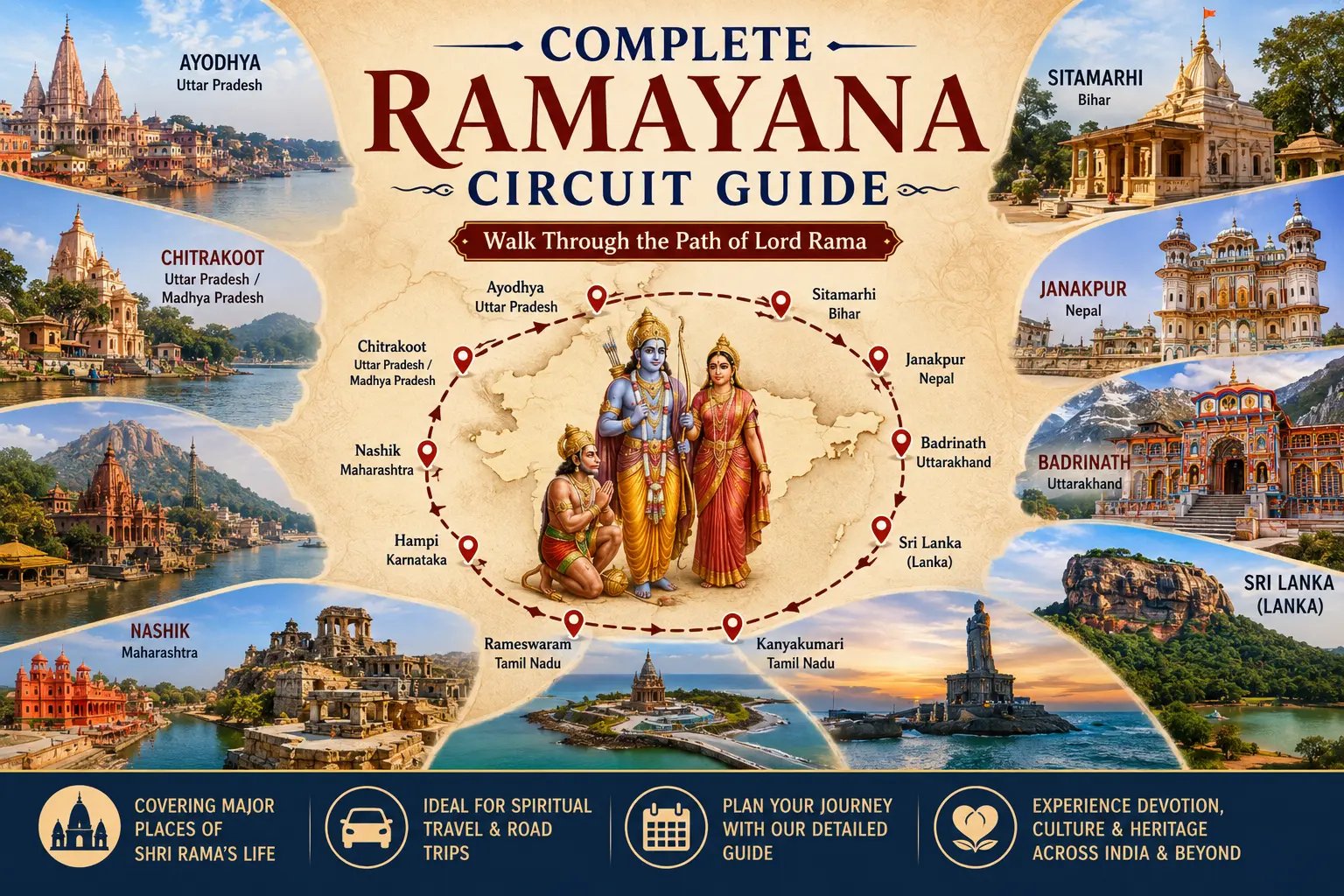
The Ramayana Circuit, also called the Ram Van Gaman Path, is a pilgrimage route that traces the journey of Lord Ram — from his birth in Ayodhya to his years of exile through Prayagraj, Chitrakoot, and beyond. The Government of India and the Government of Uttar Pradesh have both invested heavily in developing and marking this route so that devotees can travel it easily.
Millions of pilgrims do some part of this circuit every year. But most people do not know where to start, what to cover, or in which order the cities connect to the Ramayana story. This guide answers all of that — what happened in each city, how to travel between them, and how to plan the most meaningful section of this circuit in just 3 nights and 4 days.
What is the Ramayana Circuit?
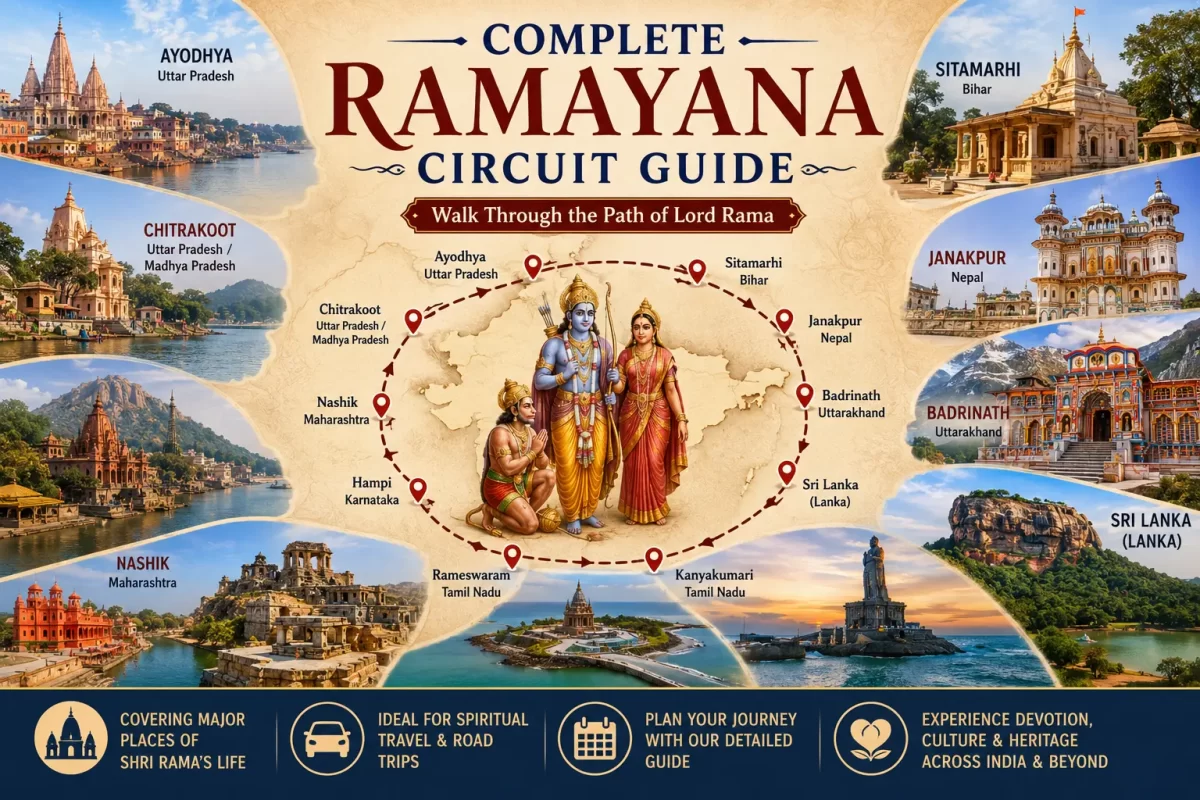
The Ramayana Circuit is an official tourism project launched by the Government of India under the Swadesh Darshan scheme of the Ministry of Tourism. It connects key cities and sites across India that are mentioned in the Valmiki Ramayana — places where Lord Ram actually lived, walked, prayed, and fought during his 14-year exile.
The full circuit spans multiple states — UP, Bihar, Madhya Pradesh, Maharashtra, Karnataka, and Tamil Nadu — all the way to Rameshwaram in the south. But the most important and most accessible section of the circuit is the Uttar Pradesh leg, which runs from Ayodhya to Chitrakoot via Prayagraj.
Separately, the UP government is also building the Ram Van Gaman Marg — a dedicated 210 km road connecting Ayodhya to Chitrakoot via Sultanpur, Pratapgarh, Shringverpur, and Rajapur. This road project is designed specifically to make pilgrimage travel along Ram’s exile route easier and more comfortable for crores of devotees.
Why These 3 Cities?
| City | Ram’s Ramayana Connection |
|---|---|
| Ayodhya | Lord Ram’s birthplace and kingdom. His exile begins here. |
| Prayagraj (Shringverpur) | Ram crosses the Ganga here. Meets Nishadraj. Visits Sage Bharadwaj. |
| Chitrakoot | Ram spends 11.5 years of exile here. Bharat Milap happens here. |
These three cities cover the very first and most emotional chapter of Ram’s exile — from leaving his kingdom to setting up his forest home. Together they form a complete, doable, and deeply moving pilgrimage that can be completed in 3 nights and 4 days.
City by City: What Happened Here in the Ramayana
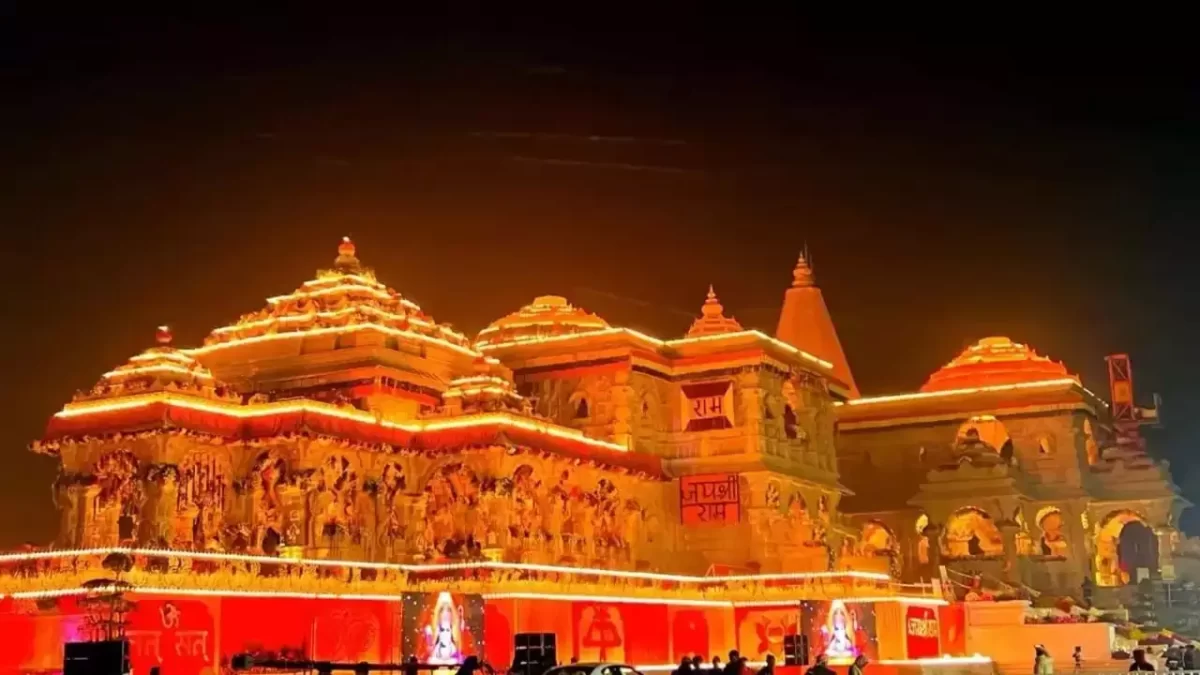
Ayodhya — Where It All Begins
Ayodhya is where Lord Ram was born, grew up, and ruled as a prince. It is also the city where everything changed — when Queen Kaikeyi asked King Dashratha to fulfill two old promises: make her son Bharat the king, and send Ram to the forest for 14 years.
Ram accepted his father’s word without a single word of protest. He gave up his kingdom, changed his royal clothes for bark garments, and walked out of Ayodhya with Sita and Lakshman. That moment of surrender and duty is what Ayodhya represents — dharma above everything else.
The temples in Ayodhya are all connected to this story:
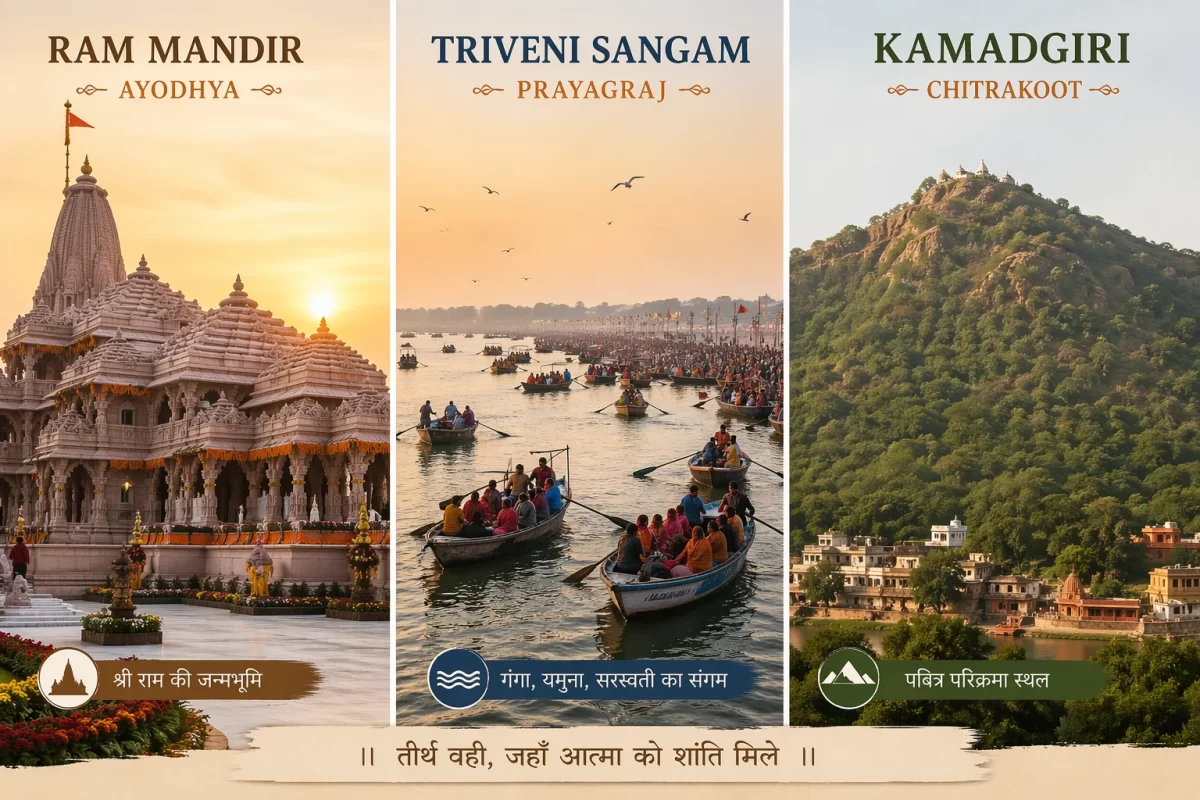
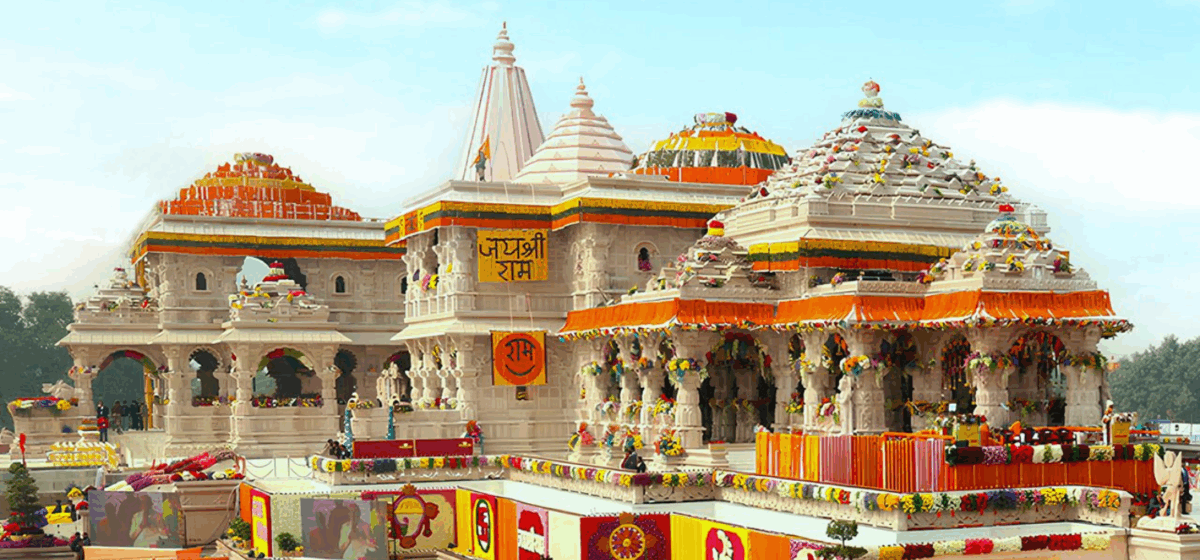
- Ram Janmabhoomi — where Ram was born
- Kanak Bhawan — the palace gifted by Kaikeyi to Sita
- Dashratha Mahal — the king’s palace where the exile order was given
- Hanumangarhi — where Hanuman is believed to have kept guard over Ayodhya
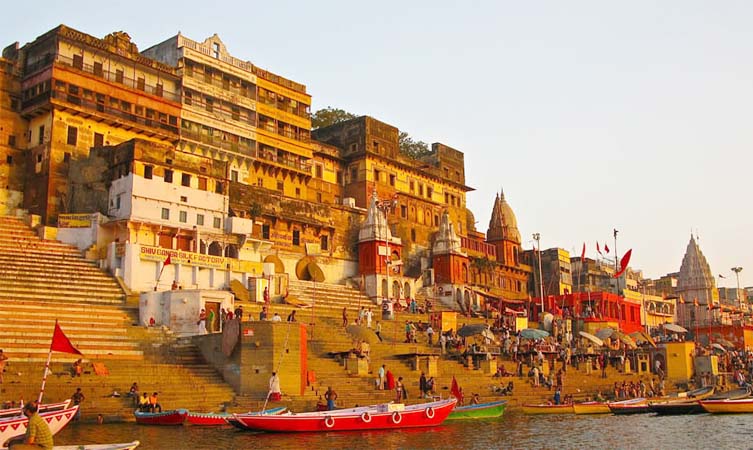
- Ram Ki Paidi and Saryu Ghat — where Ram walked to the river to begin his journey
When you stand at the Saryu Ghat in the evening, knowing Ram walked these exact steps into exile, the aarti you watch feels completely different.
Prayagraj — The First Stop of Exile
After leaving Ayodhya, Ram, Sita, and Lakshman walked south. Their first major stop was Shringverpur, on the banks of the Ganga, which is now about 38 km from Prayagraj city. This was the kingdom of Nishadraj, a fisherman king who was one of Ram’s most devoted followers.
Nishadraj helped Ram cross the Ganga in his boat. Ram spent a night at Shringverpur before crossing the river. This moment — a prince being helped by a fisherman, with full trust and love on both sides — is one of the most celebrated examples of social equality in the Ramayana. Today, the UP government has built the Nishadraj Tourist Park at Shringverpur with a 52-foot statue of Ram embracing Nishadraj.
From Shringverpur, Ram continued to Prayagraj, where he visited the ashram of Sage Bharadwaj near the Triveni Sangam. Sage Bharadwaj is believed to have given Ram guidance and directions for his forest life. The Triveni Sangam — where Ganga, Yamuna, and the invisible Saraswati meet — is considered one of the holiest spots on earth, and Ram’s presence here adds another layer to its spiritual importance.
The temples pilgrims visit in Prayagraj as part of this circuit:
- Triveni Sangam — holy dip, boat ride, darshan
- Lete Hanumanji (Bade Hanuman Ji) — reclining Hanuman idol, very rare
- Bharadwaj Ashram — the sage’s ashram, now a temple complex
- Alopi Devi Temple — an important Shakti Peeth
Chitrakoot — Ram’s Longest Stay in Exile
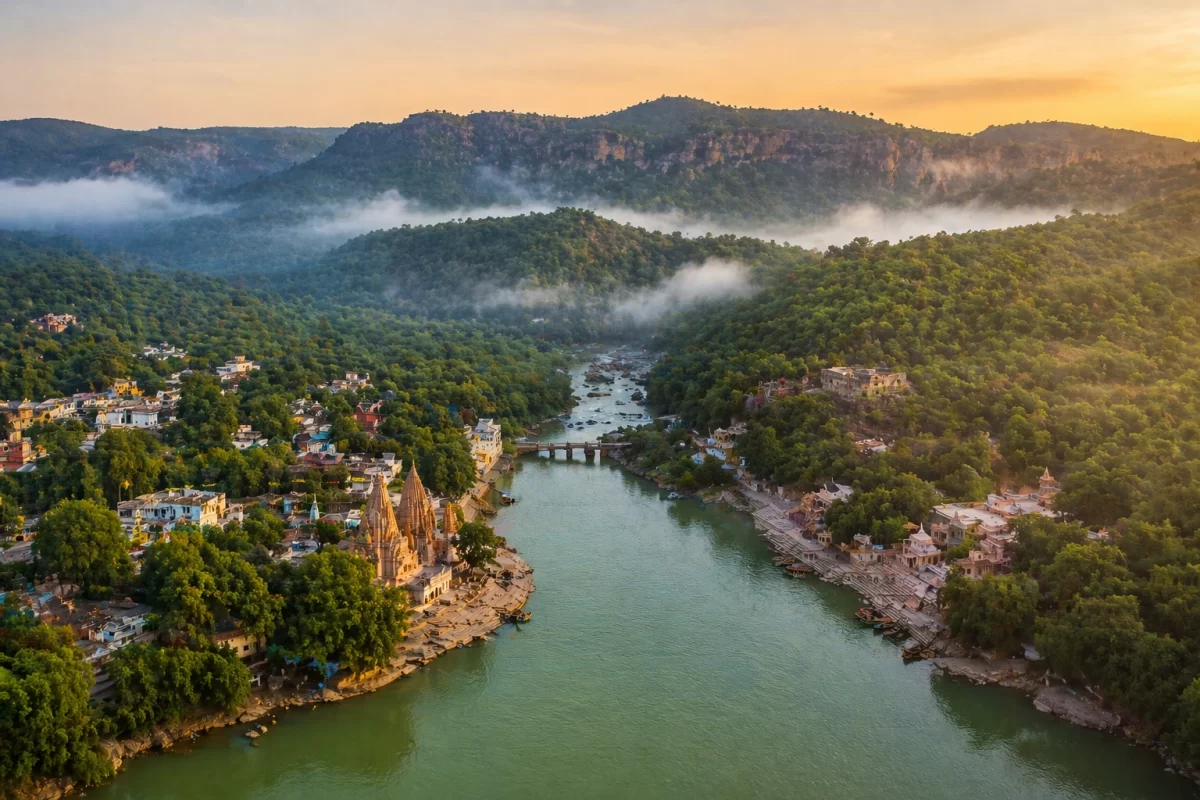
After Prayagraj, Ram, Sita, and Lakshman made their way to Chitrakoot — the forested hill town on the UP-MP border. This is where they settled. Of the full 14 years of exile, Ram spent nearly 11 and a half years in Chitrakoot — the longest stay at any single location.
Every site in Chitrakoot has a direct story from the Ramayana:
- Kamadgiri Hill — the sacred hill Ram and Sita lived on. The 5 km Parikrama path circles it.
- Ramghat — Ram’s daily bathing ghat on the Mandakini River
- Bharat Milap Temple — where Bharat came to beg Ram to return to Ayodhya. Ram refused, but took off his wooden sandals and gave them to Bharat to place on the throne. One of the most emotional scenes in the entire epic.
- Sati Anusuya Ashram — the ashram of Sage Atri and his wife Anusuya, who gave Sita special gifts during their stay
- Sphatik Shila — the rock where Ram and Sita sat together by the river
- Gupt Godavari — the caves where Ram and Lakshman held court during exile
- Bharat Koop — the well where Bharat poured water from all holy rivers for Ram’s abhishek
Chitrakoot is also where the Ramayana’s most heartbreaking moment happened — when Bharat walked all the way from Ayodhya to ask Ram to come back. Ram’s gentle but firm refusal, and Bharat’s choice to rule with Ram’s sandals on the throne instead of himself, defines the meaning of loyalty in the entire epic.
How to Travel This Circuit
| Detail | Information |
|---|---|
| Best Starting Point | Ayodhya (has its own international airport + good train connectivity) |
| Circuit Direction | Ayodhya → Prayagraj → Chitrakoot (same as Ram’s own journey) |
| Ideal Duration | 3 Nights 4 Days |
| Best Months | October to March |
| Mode of Travel | Private AC cab — most flexible and comfortable |
| Total Road Distance | ~300 km (Ayodhya to Prayagraj to Chitrakoot) |
Why Private Cab is the Best Option for This Circuit
The three cities are not connected by a single direct train or bus route that covers all three in sequence. You need to change transport at every city, manage luggage, and coordinate timings for temple visits. A private cab solves all of this — your driver knows the routes, knows temple timings, and adjusts the day based on how long you want to spend at each stop.
For families, elderly pilgrims, and first-time visitors to this circuit, private cab travel is not just more comfortable — it is significantly less stressful.
What You Feel at Each Stop — The Spiritual Dimension
Every pilgrimage has two layers — what you see and what you feel. On this Ramayana Circuit, each city gives you a completely different emotional experience.
In Ayodhya, you feel Ram’s greatness. The grand Ram Mandir, the ghats, the bhajans — everything speaks of a king who gave up everything without complaint. The feeling is one of awe and pride.
In Prayagraj, you feel Ram’s humility. At the Sangam, kneeling where three rivers meet, you understand why Ram — even as a prince — touched the feet of sages, accepted help from a fisherman, and moved through the world without ego.
In Chitrakoot, you feel Ram’s peace. The town is quiet, the forests are real, the river flows gently past the ghats. No rush, no noise. Just Ram’s daily life, still alive in the stones and trees. Most pilgrims say that Chitrakoot is where they finally feel the closest to him — not in a grand temple, but in a quiet forest on the banks of the Mandakini.
This is why doing all three cities together is so important. Individually, each is powerful. Together, they tell the complete story.
Plan Your Ramayana Circuit Today
The easiest and most complete way to travel this circuit is with a planned tour. Our Ayodhya with Prayagraj & Chitrakoot Tour Package covers all three key cities in 3 nights and 4 days — with AC cab, hotel stay, and all sightseeing managed by our local team based right here in Ayodhya.
We are not a booking platform sitting in Delhi or Bangalore. We are based in Ayodhya. We drive this circuit ourselves. We know every road, every shortcut, every temple’s opening time, and every meaningful stop along the Ram Van Gaman Path.
Thousands of families have completed this yatra with us. It can be your turn next.
📞 Call / WhatsApp: +91 9517484252 📧 Email: info@ayodhyacarhire.com 🏢 Office: Dant Dhawan Kund, Ayodhya, UP
Jai Shri Ram 🙏 | Ayodhya Car Hire UP Tourism Certified | ISO Certified | MSME Registered